
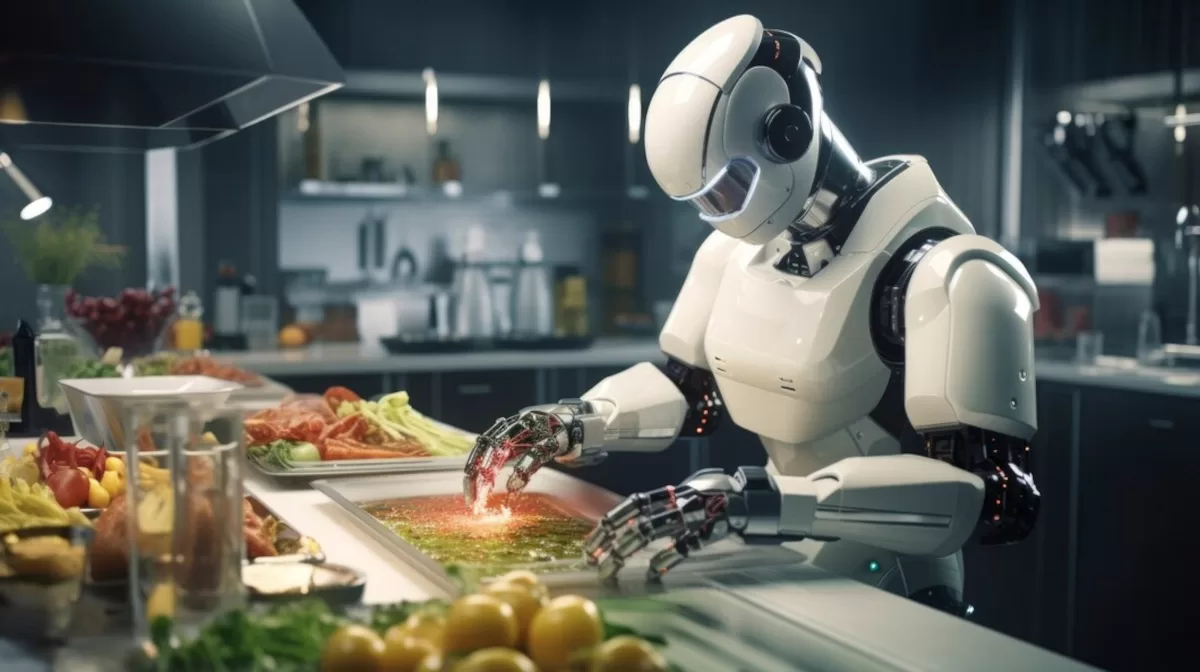
Remember when our mothers used to say “technology will spoil everything”? Well, mama might have been wrong this time. Artificial Intelligence (AI) isn’t here to replace the warmth of home-cooked meals, the thrill of discovering new places, or the soul in creative expression. Instead, it’s like having a very smart nephew who knows a bit about everything and is always ready to help – sometimes even before you ask!
If you’re over 40 and feeling like technology is moving too fast, or if you’re someone who loves good food, meaningful travel, and beautiful art, this post is for you. Let’s explore how AI can enhance these three beautiful aspects of life without losing their essence.

AI in Food: When Your Kitchen Gets a Brain Upgrade
Recipe Discovery and Customization
Think of Artificial Intelligence as that friend who somehow always knows what’s in your fridge and can suggest the perfect meal. Apps like Yuka and PlantNet can scan ingredients and suggest recipes based on what you have at home. For our Indian friends reading this, imagine having an AI that understands you want to make dal but only have toor dal instead of masoor – it will adjust the cooking time and spices accordingly.
Practical tip: Use AI recipe apps like BigOven or SideChef. They’re particularly helpful when you have leftover chapati and wondering what to do with it (the AI might suggest chapati pizza😂). Or you may want to look up a salad recipe instead.
Smart Cooking Assistance
Modern AI cooking assistants are like having your grandmother’s wisdom combined with a chef’s precision. They can guide you through complex recipes step by step, adjust cooking times based on your stove type, and even warn you when something might be burning.
For those who remember when “smart” meant you could program your VCR, today’s smart kitchen devices are refreshingly intuitive. The Thermomix TM6, for example, has AI that can guide you through making perfect biryani or even help with fermentation timing for homemade idli batter. (Don’t need Thermomix TM6 for it. We get it here in the store and home delivery too). 😀
Perhaps one needs to taste the real Biryani first before understanding the difference between the two. You may be able to fool a few who like AI tools.
(I think people who write about AI tools and articles have very little connection with the outside world. )
Nutrition and Dietary Planning
AI nutrition apps like MyFitnessPal or Cronometer have become incredibly sophisticated. They’re not just calorie counters anymore – they’re like having a nutritionist who understands your cultural food preferences. The AI can analyze your eating patterns and suggest modifications that work within your lifestyle. (Ummm…Not really. Don’t want another OCD freak in my house).
Real example: If you typically eat rice with every meal (like many of us do), the AI won’t tell you to stop completely. Instead, it might suggest brown rice alternatives or portion adjustments that feel natural. Or maybe humans help you to do that instead of AI since that is a commonly available information. How about that?
AI in Travel: Your Digital Travel Companion
Trip Planning Made Smarter
Planning a family vacation used to mean spending hours with travel agents or browsing through thick guidebooks. Now, intelligent trip planners like TripIt or Kayak’s AI features can create entire itineraries based on your interests, budget, and travel style.
The beauty is in the personalization. Tell the chatbot you’re a family of four with teenage children who love history but get bored easily, and you’ll get suggestions for interactive museum experiences and historical sites with good Instagram spots. It’s like having a travel agent who actually listens to companies who pay to get higher ratings on various accredited sites which cost you some more. Will you actually get a good experience- I don’t really know.
Or maybe the chatbot listens to your side of the envisioned future which doesn’t actually exist in reality.
Perhaps also some help might be needed to take care of the crowds which should automatically disappear while you are at the various airports or places where people connect instantly. The beauty maybe in the anonymity– if you are not very well known- you can get away with it.

Language and Cultural Navigation
Google Translate‘s camera feature has become incredibly powerful. Point your phone at a menu in Thailand or a street sign in Morocco, and get instant translations. But here’s where it gets interesting – newer translation tools like DeepL are beginning to understand context and cultural nuances better.
For Indian travelers, this is particularly useful when visiting countries where English isn’t widely spoken. The AI doesn’t just translate words; it helps you understand cultural contexts. For example, it might explain that in Japan, slurping noodles is actually polite!
Also it might explain that there’s nobody who is helping you to buy the noodles currently and that you can get it in your hometown if you ask more politely.
Smart Booking and Price Optimization
AI-powered booking platforms like Hopper analyze millions of flight prices and can predict when prices will drop. It’s like having a crystal ball for travel deals, but based on data rather than mysticism.
Pro tip: These AI systems work best when you’re flexible with dates. If you can travel within a week’s window, the savings can be substantial – sometimes enough to upgrade your accommodation!
Personalized Recommendations
AI travel apps now learn from your preferences. Stay in boutique hotels twice, you will start seeing similar options. Love local markets? It will highlight the best ones in each destination. It’s like traveling with a friend who remembers everything you’ve ever liked.
I have a feeling, that friend doesn’t actually remember everything you’ve ever liked because perhaps that friend never existed. It only takes what you give. And then takes some more from others who give more. How about that?
Artificial Intelligence in Arts: Creativity Meets Technology
Digital Art Creation
This is where things get really exciting (and sometimes controversial). AI art generators like DALL-E 2, Midjourney, and Stable Diffusion have opened up artistic expression to everyone. You don’t need to know how to draw to create beautiful artwork anymore.
Think of it like this: if traditional art is like cooking from scratch, AI art is like having a sous chef who can execute your vision perfectly. You’re still the creative director; the AI is just helping with the technical execution.

Music Composition and Enhancement
AI music tools like AIVA or Amper Music can help compose background music for your videos or even help you write songs. For those who’ve always wanted to create music but couldn’t read notation or play instruments, this is revolutionary.
Classical music enthusiasts might find it particularly interesting for exploring ragas and talas. Some AI tools can analyze classical compositions and help you understand the mathematical beauty behind them.
Writing and Content Creation
Writing assistants (like the one you might have heard about – ChatGPT or Grammarly) have become incredibly sophisticated. They’re not replacing writers, but they’re excellent brainstorming partners and editors.
Personal anecdote: I use them to help overcome writer’s block. When I’m stuck, I ask it to suggest different angles or help me restructure arguments. It’s like having a writing buddy who never gets tired of your drafts.
Sure it doesn’t tire of your drafts but somebody may not pay you to venture outside with your drafts to the world. Decision making is tough in a rabble-rousing crowd. That’s what I understand is the fallacy of AI. Unless you are able to get your draft ahead of others’ drafts. And somewhere the draft needs to be refined later with feedback. Unfortunately, humans who work with AI are not used to feedback which is not from a best friend.
Art Curation and Discovery
AI-powered platforms like Google Arts & Culture can help you discover artworks based on your preferences. Take a photo of a painting you like, and they can find similar styles or even tell you about the techniques used.
For old art lovers [over 40], this is particularly valuable. Remember how we used to spend hours in libraries researching artists? Now that research happens instantly, leaving more time to actually enjoy and create art.
Do try this even for art lovers below 40. I do think- they maybe otherwise engaged with chatbots instead of admiring art and it might do them good to interact with the world outside to learn more.
The Human Touch in an AI World
Here’s the thing that many people worry about: will AI make these experiences less human? The answer is no – if we use it right.
AI in food doesn’t replace the love in a home-cooked meal; it helps you cook better and discover new flavors. Artificial Intelligence in travel doesn’t replace the joy of discovery; it helps you discover more efficiently and meaningfully. AI in arts doesn’t replace human creativity; it amplifies it.
It may also help you to not cook at all and instead wait for others to cook. Because somewhere you are prone to letting others do the work instead of doing it yourself.
Might be time to actually go and sleep. And let the AI chats also sleep forever.
Getting Started: Practical Steps
For the Curious Beginner:
- Start small: Download one Artificial Intelligence app related to your interests like Claude, Gemini or ChatGPT .
- Experiment safely: Try recipe suggestions with familiar ingredients first
- Learn gradually: Don’t try to use every available Artificial Intelligent tool at once
For the Tech-Comfortable User:
- Integrate AI into existing routines: Add these tools to workflows you already have
- Explore advanced features: Most AI tools have deeper capabilities once you’re comfortable
- Share and learn: Join online communities discussing AI applications in your areas of interest
I’m unable to integrate AI into routines which involve humans who are trying to extract instead of giving back to the society. Unfortunately, we have to deal with such people too who believe in only taking and giving nothing back.
Common Concerns and Honest Answers
“Will AI make me lazy?” No more than using a microwave made previous generations lazy. AI tools are just that – tools. They can make certain tasks more efficient, leaving you more time for the parts you enjoy most- like say not cooking. In which case, you wouldn’t be on this blog now- would you? You would be rather using it to instruct others to work for you foolishly or stupidly because they have no choice and pay them the minimum required with maximum returns. Or perhaps opt out to go looking for something like raw foods, food delivery or frozen dinners so that you don’t need to actually cook.
“Is it too complicated for someone my age?” Modern AI interfaces are designed to be intuitive. Many are actually easier to use than the technology you’ve already mastered. If you can use a smartphone, you can use most AI applications.
“Will it cost too much?” Many powerful AI tools are free or very affordable. The investment is often less than what you might spend on a single dinner out or a weekend trip. Yes- a much-needed investment for those who wish to start their own restaurants or food service business perhaps. Some of these don’t need AI tools and don’t work very well with AI tools. Suggest you develop this business first to know more.


Here’s my take- you maybe cute or funny today. Not so when you are 30 or 40 or even 50.
Somewhere there’s an assumption that others are fresh idiots who are not using AI. That arrogance itself may hamper the growth of AI.
Looking Forward: The Future is Collaborative
The most exciting aspect of AI in food, travel, and arts isn’t the technology itself – it’s how it’s enabling human creativity and exploration. We’re not heading toward a world where robots cook all our meals or AI creates all our art. We’re heading toward a world where these tools help us explore our interests more deeply and express ourselves more fully. Perhaps part of those interests doesn’t include food and cooking. That might be the main issue at hand as I understand.
Whether you’re a grandfather wanting to document family recipes, a middle-aged professional planning your dream vacation, or someone discovering their creative side later in life, AI can be your thoughtful assistant rather than your replacement.
The key is to approach it with curiosity rather than fear, and remember that behind every AI tool, there are humans who designed it to help other humans live better, create more, and explore further.
So go ahead, ask that AI assistant about fusion recipes, let it help plan your next adventure, or collaborate with it on your creative projects. The future of food, travel, and arts is not human versus AI – it’s human with AI, and that future tastes, looks, and feels pretty amazing.
There are younger devils in older grandfathers, mothers and sisters too. Middle aged or younger kids- there are all kinds of people using and abusing their brains to try to fool others.
So kindly try this instead- find another way to express yourself more fully. That was my simple understanding of how the world works. If we turn a blind eye to others- you get a blind eye in return.
What’s your experience with AI in any of these areas? Have you discovered any tools that have genuinely improved your cooking, traveling, or creative pursuits? Share your stories in the comments below – we’d love to learn from your experiences!
Check some of our amazing recipes
Footnote

Compare this to this. No more inputs from grandmas. Do everything on your own.
Get the AI robots to man your kitchen while you live in your own little bubble
In a make belief world – perhaps on Planet Mars
No more ang paos or any more little salaries
No more little notes on birthdays
Nobody to give you any advice or any kind of help
No more inheritances, or places to live
No more fall-back cushions
No more great gambling options on the stock market
No more banks to deal with or documents
Because all of them were confiscated one day
Grandmas come with grandpas too
Try them next.
Melting Lemon Drop 07.09.2025

2 comments
wow,
Beautiful read
True- it’s a good read. Kind of difficult to do it all yourself. I may need a little sling. 🙂